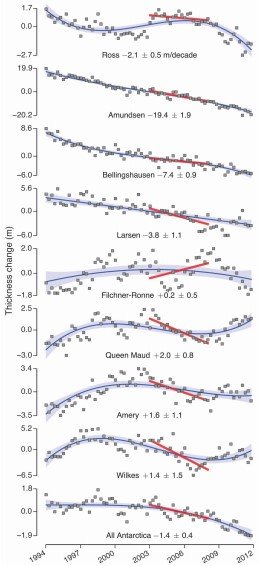
Time series of cumulative thickness change relative to series mean for Antarctic ice-shelf regions (1994–2012). Time series correspond to averages for all ice-shelf data within the Antarctic regions defined in Fig. 1. Dots represent average thickness change every 3 months. Error bars are small (in many cases, smaller than the symbols themselves, thus omitted from the plots), making the interannual fluctuation shown by the dots significant. The blue curve is the long-term trend from polynomial regression with the 95% confidence band (18), and the red line shows the regression line to the segment of our data set that overlaps with the period used for a prior ICESat-based analysis (2003–2008) (5). Average rates (in meters per decade) are derived from the end points of the polynomial models.
source: Paolo, F. S., Fricker, H. A., & Padman, L. (2015). Volume loss from Antarctic ice shelves is accelerating. Science, 348(6232), 327-331.